


The artificial lens you choose to replace your clouded natural lens during cataract surgery will become a permanent part of your eye. Much of your vision range after the procedure depends largely on which IOL you select.
While standard lenses can restore clear distance vision, premium IOLs offer advanced features that can significantly reduce or even eliminate your dependence on glasses for daily activities. Today’s cataract patients have more choices than ever before when it comes to premium IOL options. Each type of advanced lens addresses different vision needs and lifestyle goals.
Keep reading to learn about six premium IOL technologies that can help you achieve the visual freedom you’re looking for after cataract surgery at Loden Vision Centers!
What Makes an IOL “Premium”?

An IOL is a clear artificial lens that your surgeon implants during cataract surgery to replace your eye’s natural lens. Standard IOLs, which are typically covered by insurance, correct vision at one fixed distance (usually far away). This means you’ll likely still need reading glasses or bifocals after surgery.
Premium IOLs go beyond basic vision correction. These advanced lenses use sophisticated technology to address multiple vision problems at once. They can correct astigmatism, reduce your need for reading glasses, or provide a full range of clear vision from near to far. The result is greater visual independence in your daily life.
While premium IOLs involve an additional out-of-pocket cost, many patients find the investment worthwhile for the convenience and quality of life benefits. The team at Loden Vision Centers can help you understand which premium option aligns best with your visual goals and budget.
Premium IOL Option #1: Multifocal IOLs
Multifocal IOLs work like progressive or bifocal glasses, built right into the lens. These lenses have multiple zones that allow you to see clearly at different distances. The design splits incoming light to create distinct focal points for near, intermediate, and far vision.
Most patients who choose multifocal IOLs can read, use computers, and drive without glasses. The brain learns to select the appropriate focal zone for whatever task you’re doing. This adaptation typically happens within a few weeks after surgery.
These lenses work best for patients who want maximum independence from glasses and are willing to accept some visual trade-offs. Some people notice glare or halos around lights at night, especially in the first few months.
If you spend a lot of time driving at night or have demanding visual tasks, discussing these factors with your eye doctor is essential.
Premium IOL Option #2: Extended Depth of Focus (EDOF) IOLs
EDOF IOLs provide a continuous range of vision rather than distinct focal points. These allow you to have a smooth transition in clarity from distance vision to the intermediate range.
Since it stretches the depth of focus, it gives you functional vision for activities like using your phone, working on a computer, and seeing across a room.
The main advantage of EDOF lenses is that they cause fewer visual disturbances than traditional multifocal IOLs. Patients typically experience less glare and fewer halos around lights at night. So, you’ll have better quality distance and intermediate vision with minimal side effects.
These lenses are ideal for active patients who prioritize clear distance and computer vision but don’t mind using reading glasses occasionally for very small print. If night driving is a regular part of your routine, EDOF lenses might offer a good balance between range of vision and visual quality.
Premium IOL Option #3: Toric IOLs
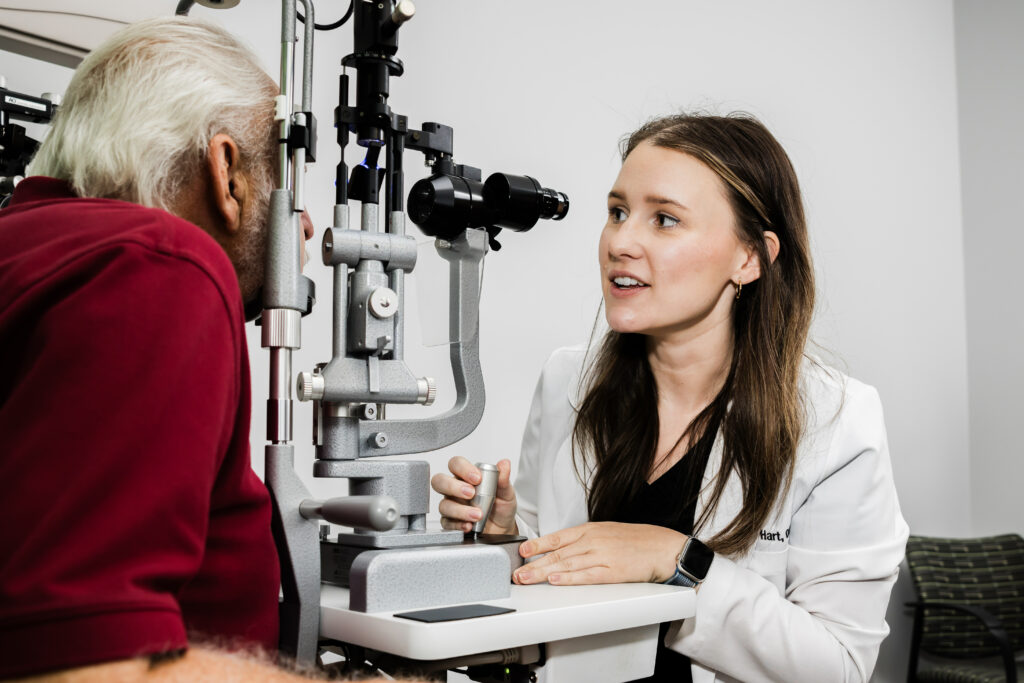
If you have astigmatism, your cornea has an irregular shape (more like a football than a basketball). This causes blurred or distorted vision at all distances. Toric IOLs are specifically designed to correct astigmatism along with your cataract surgery and can be a good option for patients with moderate to high astigmatism.
Standard IOLs cannot correct astigmatism, which means you’d still need glasses or contact lenses after surgery to see clearly. Toric lenses have different powers in different meridians to compensate for your cornea’s irregular shape. The surgeon precisely aligns the lens during surgery to match your specific astigmatism pattern.
Premium IOL Option #4: Trifocal IOLs
Trifocal IOLs take multifocal technology a step further by adding a third focal point specifically for intermediate vision. You get clear vision at near (reading), intermediate (computer and dashboard), and far (driving and TV) distances.
The intermediate zone can be particularly valuable for those who are on the computer a lot. You can comfortably see your computer screen, check your phone, and read the grocery store shelf labels without constantly adjusting your position or reaching for glasses.
Keep in mind that the trade-off for this range of vision is a slightly higher chance of experiencing halos or glare, especially during the adjustment period.
Premium IOL Option #5: Accommodating IOLs
Accommodating IOLs attempt to mimic how your natural lens worked when you were younger. These lenses are designed to move or change shape slightly in response to your eye muscles, similar to how your eye naturally focused before presbyopia set in.
When you look at something far away, the lens shifts into one position. When you look at something up close, it moves to provide near focus. This creates a more natural focusing experience compared to multifocal lenses, which use optical zones.
The amount of near vision they provide can vary from person to person. They’re a good option if you want some near vision improvement with minimal visual disturbances.
Premium IOL Option #6: Light Adjustable Lens (LAL)
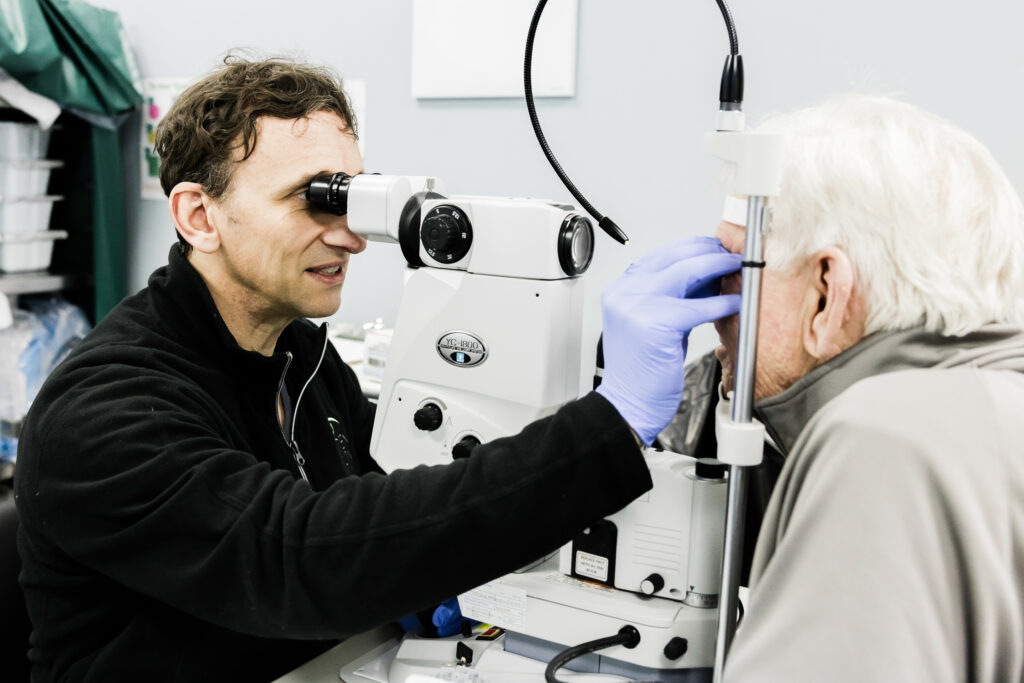
The Light Adjustable Lens offers something unique: the ability to customize your vision after your eye has healed from surgery. This IOL contains special molecules that respond to ultraviolet light. About two to three weeks after your surgery, your doctor uses a light delivery device to fine-tune the lens power.
During adjustment sessions, you can actually test different vision outcomes before making them permanent. Want to optimize for distance? Or prefer better reading vision? You can try various settings and choose what works best for your lifestyle. Once you’re satisfied, a final light treatment locks in your choice.
This technology is particularly valuable if you’re unsure exactly what vision outcome you want or if you have specific visual demands that require precision. The LAL gives you more control over your final result than any other IOL option currently available.
Taking the Next Step Toward Clearer Vision
The variety of premium IOL options available today means you have real choices about your vision after cataract surgery. From multifocal lenses that minimize your need for glasses to specialized toric lenses that correct astigmatism, there’s likely an option that fits your visual goals.
The key is working with an experienced surgeon who can assess your eyes, understand your lifestyle, and recommend the best technology for your needs.
Are you ready to explore which premium IOL option is right for you? Schedule a comprehensive cataract evaluation at Loden Vision Centers in Nashville, TN, today.


